

TURPINE FOR CANCER Complementary Therapy For Arthritis, ALS, Parkinsons, Autism, MS, Lupus, Arthritis, Tinnitus, get worms out!
immune molecules and (turpine) pine bark, a foundational piece to healing


Turpentine – Incredible Accoutrement for Cancer ALS Parkinsons Arthritis tinnitus MS Lupus, other diseases
“Turpine uses, these are not folklore. They are fragments of a medical tradition that was displaced by a pharmaceutical economy that had no use for a substance anyone could buy at a hardware store for a few dollars.”—- Unbekoming substack
Many books have been written for you to browse on this topic and Unbekoming, one of my subscribers, wrote a great Substack here, after I wrote the story of Michael using turpine which transformed his life. DMSO and turpentine are both from pulping, by dissolving lignin, turpentine or turpine is distilled resin of living pine trees, a byproduct of pulping and inexpensive, safe, doesn’t come with the negative side effects of prescription drugs nor conventional cancer treatments. Plus, it’s great for prevention and general health maintenance. Because people equate it with the paint industry, it’s not on their radar to use it in regards to health.
FROM MY CLIENT
“You can share my story not my name: Years ago I read an interesting article in Russian and tried clarified kerosine my husband already had. I had no symptoms just young and stupid. Took 2 tablespoons, did not think if any side effects would occur. Did not eat nor drink for a few hours. After two days, a very long white worm came out. I could not believe it!”
MICHAEL USED TURPINE
MUST WATCH (click) MICHAEL HOW HE STOPPED BEING GAY - he teaches us this - since age 14 gay porn ran through his brain all day until turpine parasite cleanse 9 months! Then he got married and had kids. WOW!


MY GOOD FRIEND DR ROBERT YOHO BROUGHT DMSO BACK TO THE GLOBE MAY 2024 (after your Govt lied about it 60 years) THEN MIDWESTERN DOC 4 MONTHS LATER, THEN UNBEKOMING

Sign up for a free 3 wonderful Substack authors, Doctor Yoho (on best chance to heal PARKINSONS here), or Unbekoming or MidWestern Doc (on DMSO) subscription to review the platform. A paid subscription unlocks all fifteen of UNBEKOMING’s books — including the DMSO book, plus his titles on cancer, vaccines, birth, hormones, and screening. Doctor Robert Yoho has arranged for you a gift from Unbekoming on DMSO ( and here Yoho writes on Parkinsons best bet to heal or slow progression), his discount until May 7th, so my readers have THREE DAYS to consider this modest cost before his price goes up.
Download and enjoy the DMSO book below. Let me know what you learn, in the comments.

The DMSO Book V1 1.88MB ∙ PDF file
PARASITES SEND MESSAGES TO GET YOU TO STOP KILLING
Here is the story of Michael (click) who teaches the world, he thought he was gay age 14-30. Once he did a parasite cleanse, he stopped anal cravings, no longer gay. The journey led him to understanding the parasites caused him to not only crave sugar but also the desire for anal all day long and the messages that got to his brain were to stop the parasite kill. Buy turpine here. Yes this sounds nuts so OPEN YOUR MIND to “maybe.”
LEARN SO MUCH WITH ME, STEP 1
is to click green button below to be a member and use the FOUNDING MEMBER button to get a 2-3 year membership here:
STEP 2, IMMUNE MOLECULES HEEAL SO MUCH DIS-EASE
4Life researches and develops products that educate different kinds
of immune cells, including Natural Killer (NK) cells, B cells, T cells,
and macrophages.*†
3. 4Life has pioneered Transferceutical™ Science and is dedicated to
continually learning more about transfer factors!From Unbekoming, “A couple of years ago I had a bladder infection that was so painful I prayed for death, it was excruciating, left me bawling in pain, no medication was working, I was on a plant-based diet at the time, ate raw cranberries. Out of desperation, willing to die at that point, I took out my turpentine, poured a tablespoon or two into a cup, and drank it. Within twenty minutes I was healed, I thank God for this, and have told all my family and friends.”
pinee.net (the one dr daniels mentions in this podcast) only sells turp in 2 oz. Unbekoming suggests diamond g forest who offers it in 16 oz and 32 oz
You can see how I helped a client and her husband and 3 kids heal scabies in 3 months after all of her research told her it would take a year, here.
Most people associate turpentine with paint because it’s used as a solvent and paint thinner, but what you may not know is that it’s been used as a healing remedy for centuries. Pure gum turpentine, or pine tree oil, comes from distilled pine tree sap or resin, and is used as a complementary therapy for cancer and other diseases. Turpentine has antioxidant properties, is anti-proliferative and prevents mutations. For thousands of years it’s been touted as a cure-all for many conditions
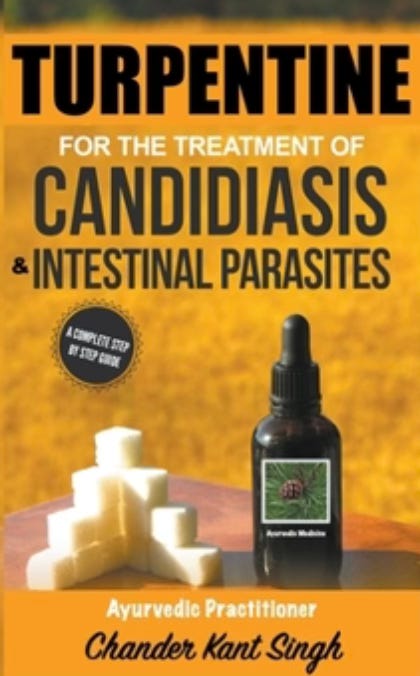
There is a complicated name most people will never remember: oligomeric proanthocyanidin complexes, or OPCs. However, what matters is what they do. These compounds are connected to turpentine, and they have been studied for their ability to slow cancer cell growth and even trigger cancer cell death. That matters because we are always told there are no simple, low-cost answers.
Turpentine is not new, has a long history most have n’r been told. When I worked with Merck and helped launch Vioxx, I saw firsthand how modern medicine can go very wrong. That pill killed man souls and I was part of its launch. Yet if you go back to the 1899 Merck Manual, turpentine was clearly listed as a remedy across multiple conditions. That contrast stayed with me.
What also stands out is how inexpensive it is. A single pint can cost around $15 and may last up to two years depending on use. Meanwhile, it comes from something simple: the distilled resin of pine trees, especially those found in the southern United States. Nature already provided it.
People have historically used turpentine for a wide range of issues. This includes arthritis, lung conditions, digestive problems, and hormonal imbalances. Additionally, it has been discussed in alternative health circles as part of cancer protocols involving the breast, liver, spleen, and rectum. Whether or not every claim holds, the consistency of its historical use is hard to ignore.
Another reason people talk about it is its solvent nature. Because of that, some believe it can help break down stored toxins or residues in the body. This is often mentioned when discussing long-term toxin accumulation.
However, purity matters. Only 100% pure gum spirits of turpentine should ever be considered. Moreover, dosage is critical. Typically, no more than one teaspoon per day is suggested for someone under 240 pounds. Interestingly, higher body weight does not mean higher dosage. In some cases, less may be more.
When you look at it this way, you start to ask different questions. Why are older remedies forgotten? And why do the simplest options often get ignored?

.
Most people never think about this, but it matters more than almost anything else.
Every organ in your body is wrapped in fat. Not random fat. Protective fat. The pancreas has it. The liver has it. The heart, kidneys, even the thyroid. It is there for a reason. It cushions, protects, and feeds the organ. However, when things go wrong, that same fat becomes a storage site.
This is where the body hides what it cannot easily remove.
I started paying attention to this because it explains so much. You can eat well, you can try to detox, and yet something still feels off. That is because fat-soluble toxins do not just leave. Instead, they get parked in that fatty layer around your organs.
Dr. Tom Cowan explains this in a way that makes sense. A toxin that dissolves in fat settles into that protective layer. Then slowly, it begins to interfere with how the organ works. If that organ is the pancreas, digestion starts to weaken. Blood sugar becomes unstable. You eat the same food, yet your body handles it differently. Meanwhile, because digestion weakens, more waste builds up. That creates more stress, more toxicity, and more imbalance.
Then the cycle begins.
The original toxin is still sitting there. However, now new exposures are added on top of it. The organ becomes less efficient. Symptoms appear. A label is given. Then medication is introduced.
And this is where most people never stop to question anything.
Because while the label changes, the root does not. In many cases, the added medications bring their own toxic load. So instead of breaking the cycle, it quietly tightens.
When you look at it this way, it is not random. It is a spiral.
This is why the conversation around turpentine keeps coming up in alternative health spaces. The claim, and it is a big one, is that it works differently. Instead of managing symptoms, it targets the place where toxins are actually being stored.
The fatty envelope.
That matters because most approaches never reach that layer. Water-soluble detox methods move through the bloodstream and out. However, fat-soluble toxins behave differently. They stay put. They linger. They accumulate.
So when something is said to break down fat-soluble toxins, people pay attention.
Now, that does not mean everything claimed is proven. It does mean the mechanism is worth understanding. Because once you see how the body stores toxins, you cannot unsee it.
And this leads to a much bigger question.
If the body is dealing with two completely different types of toxins, fat-soluble and water-soluble, then why are we treating everything the same way?
That is where things start to shift.
Two Classes of Poison UNBEKOMING MENTIONS
Your body clears two kinds of toxins, each behave very differently. The first class is water-soluble, enter the bloodstream, move through kidneys, exit urine. Your body’s clean-out systems, kidneys, liver, sweat, bile, are built around water-soluble chemistry. A water-soluble toxin can be unpleasant and damaging, but the exit route is short and the body knows how to take it.
The second class is fat-soluble. Unbekoming explains, do not dissolve in water, dissolve in fat. When they enter the body, they are drawn to fatty tissue, and not all fatty tissue equally. They accumulate preferentially in the visceral fat compartment: the fat around organs, inside the body cavity, closest to the structures whose function matters most.
UNBEKOMING points out: Persistent organic pollutants, official category name, described in peer-reviewed studies as lipophilic, fat-dissolving, preferentially accumulated in visceral adipose tissue,² such as polychlorinated biphenyls (PCBs), the dioxins, DDT and its metabolites, polybrominated diphenyl ethers (PBDEs), and many organochlorine pesticides.³ Glyphosate (RoundUP weed killer sprayed on veggies, beans, soy, corn, wheat) metabolites, numerous industrial solvents, and most pharmaceutical residues belong to the same class.
Unbekoming presents literature these compounds accumulate in visceral fat for years, our body has no efficient route for clearing and weight loss mobilizes them. Unbekoming shows us in his terpene article, 2015 study, The Journal of Clinical Endocrinology & Metabolism, s6 months after large weight loss, serum PCB levels rose 50%, with visceral fat compartment implicated as the dominant source of release.⁴ 2024 study in Environmental Science & Technology tracking adolescents through bariatric surgery found that mobilization of stored lipophilic POPs from visceral adipose tissue correlated with measurable blood pressure elevation five years later,⁵ so, toxins are released back into circulation, not eliminated, find new fatty tissue to lodge in, or they damage tissue on the way through.
Unbecoming points out that, “your body is mostly water and your kidneys filter water. Sweat is water. Bile is water-based. A water-based clearance system cannot dissolve something that by definition refuses to dissolve in water. Something else is required. Something that does in the body what turpentine does on a painter’s brush: dissolves the fat layer so that what is dissolved in it can go.”
How to Explain It to Over-Vaccinated Vax Lovers
Unbecoming said it well. “Imagine a kitchen sponge that has been used to wipe up grease. The sponge is soaked with it. You rinse the sponge under the tap. The water runs off clear, but when you squeeze the sponge, the grease is still there. Water does not dissolve grease. Now imagine that sponge has a job to do. It is meant to absorb things and release them, over and over. With the grease inside, it cannot do the job well. The more it tries, the more tired it gets, and the dirtier the things around it become. Water can rinse and rinse and the grease will stay exactly where it is.
What you need is soap. Soap dissolves grease. When you rub soap into the sponge, the grease breaks up, lifts off, and flows away with the water. The fatty parts of your body are like that sponge. Some poisons dissolve in water and leave in your pee. But some poisons dissolve only in fat, and they get stuck in the fat around your organs, and the water in your blood cannot wash them out — any more than water can wash grease out of a sponge.
Turpentine is the soap.”
The Medicine That Was Standard
Unbecoming, “The 1899 Merck Manual, first edition of the oldest continuously published English-language medical textbook, lists turpentine as a standard remedy,⁶ It appears under the treatment of colic spasms alongside ammonia and belladonna. It is referenced throughout the volume. One newer drug introduced in the same manual, Alantol, is described in a single telling line: “Instead of turpentine, in pulmonary affections.”⁷ The newer substance is defined by reference to turpentine. Turpentine was the standard against which newer drugs were measured.
This was not an obscure folk treatment being quietly acknowledged. This was Merck, in 1899, describing the materia medica in actual use by American physicians.
The history runs back further. Ancient Babylon used petroleum distillates and pine resins to treat stomach problems, inflammations, and ulcers.⁸ The distillation of crude oil into separable hydrocarbon fractions was first described in ninth-century Persia. Turpentine was carried as standard medicine aboard Ferdinand Magellan’s fleet during the first circumnavigation of the globe, valued for its antiseptic properties, its action against intestinal parasites, and its use in respiratory conditions.⁹ It was used for centuries in the naval medicine of Europe. Walter Last, the retired Australian biochemist whose research on kerosene and turpentine collected much of this historical material, cites a modern Nigerian study finding that roughly seventy percent of the population still uses petroleum distillates medicinally.¹⁰ In Russia, Eastern Europe, and across much of Africa, the practice never stopped.
Within the United States, Dr. Jennifer Daniels recovered another piece of the record: the remedy that was in common use among American slaves. A teaspoon of turpentine dissolved in sugar, taken several times a year, reportedly kept people free of the diseases that surrounded them.¹¹ Daniels rebuilt the protocol and made it the basis of her clinical work. The practice, passed between households rather than through medical journals, survived the decades when official medicine pretended it did not exist.
Turpentine was standard in 1899, traditional long before that, and quietly continuous across much of the world into the present day.
Kerosene and Turpentine Therapy
UNBEKOMING APRIL 19, 2025 Read full story
How It Was Removed From the Record
Unbekoming teaches us that, “after the Second World War, antibiotics arrived, as older pharmacopoeia — herbs, resins, distillates, mineral preparations — was displaced by patentable compounds manufactured by pharmaceutical firms. By mid-century, a substance whose use had been taught in medical schools for generations was no longer taught at all. Displacement by commercial competition explains quiet obsolescence. It does not explain what came next.
This is one of those stories you do not forget once you hear it.¹²
In the early 1950s, a woman named Paula Ganner was just 31 years old. She had advanced cancer. Surgery had gone wrong. Her colon stopped working. Doctors told her she had two days to live. However, she remembered something most people today would never even think about. She grew up in Eastern Europe, where kerosene was used as a kind of cure-all. So instead of accepting the outcome, she made a decision. She started taking a tablespoon a day. Within three days, she was out of bed.¹²
That alone stops you.
But the story keeps going. Eleven months later, she gave birth to a healthy son. Then three years after that, when her child came down with polio, she used the same idea in a much smaller dose. Within days, he recovered.¹²
When you read something like this, you cannot just brush it aside. At least, I cannot.
So she did what you would expect. She started sharing what happened. Over time, she received thousands of letters from people trying the same approach. Many of them described improvements in cancers, tumors, chronic illnesses, and even childhood conditions.¹³ Eventually, a German publication called 7 TAGE began printing these testimonials. For a short period, real experiences were being shared openly.¹³
And then it stopped.
The editor lost his job. Mentions of petroleum-based remedies were removed from official records. Something that had once been normal was suddenly labeled dangerous. No clear data was presented. No real case reports were shown. The narrative simply shifted.¹⁴ Years later, cases even went to court. A woman in Germany was prosecuted for sharing information about kerosene use. However, no harm could be proven. Even the medical expert involved said that for serious illness, anything that might help should at least be studied properly. The case was dropped.¹⁵
In places like Australia, kerosene that had once been clear suddenly began to be dyed. Warning labels appeared. Over time, the language around it became more extreme, even though the underlying data was not clearly presented.¹⁶
A substance is used. People report results. Then the narrative shifts. Access changes. Warnings increase. Eventually, the original context disappears. What remains is a simple conclusion: dangerous, do not use.
In France, kerosene still appears in traditional listings under another name, used for respiratory and urinary conditions.¹⁷ That alone should make you stop and think.The medicine did not stop working. The mechanism did not change. What changed is that the medicine briefly threatened to be noticed, and the institutions whose authority depended on not acknowledging it moved to close the opening. A remedy that was standard in 1899 is described, in 2026, as too dangerous to discuss.
In France, the record remained intact. Kerosene appears in the French pharmacopoeia to this day as huile de Gabian, prescribed for bronchitis, asthma, and cystitis.¹⁷
Four Uses
Cowan describes four uses, three with long continuous history and one he has added in his own life. by Unbekoming:
Oral. A small dose: teaspoon, taken on a sugar cube or honey on an empty stomach, before breakfast or at bedtime, absorbed in the upper intestine, enters bloodstream, reaches fatty compartments where its solvent action operates. Practitioners recommend graduated courses: starting with a few drops, building to a teaspoon daily across a few weeks, returning to smaller doses. Exact protocols vary. Jennifer Daniels’ book Do You Have the Guts to Be Beautiful? sets out her version.¹⁸ Cowan’s clinic has its own written protocol for members. Andy Kaufman has discussed the oral approach in detail in his podcast interview with Cowan. Readers wanting a specific dosing protocol should consult those sources rather than this essay.
Inhalation. A few drops of turpentine: added to a bowl of hot water, a steam inhaler, or a nebuliser produces a vapour that penetrates the lungs. Cowan reports using this form extensively in his clinical practice for congestion, cough, chest tightness, respiratory infection. Of the four uses, this is the one with the longest continuous history — straight through the naval medicine of the Age of Discovery to the present.
Topical. Turpentine mixed with a carrier oil": olive oil, coconut oil, tallow, ghee, one part turpentine to one or two parts oil is rubbed into the skin over painful joints, stiff areas, or localized deposits. The solvent action operates directly on whatever fat-bound material has accumulated in the tissue beneath. Undiluted turpentine on skin will redden and blister after ten to sixty minutes depending on skin sensitivity; this is sometimes used deliberately to draw inflammatory material to the surface, but the diluted form is standard for regular application.
Dietary incorporation. Cowan adds a tablespoon of turpentine to a blend of raw-milk kefir, frozen berries, raw egg yolks, fermented honey, cardamom extract, he and wife drink over 2-3 days, offered as an example of low-dose ongoing incorporation for those who prefer that to periodic cleanses.
What to Buy
True turpentine is distilled from pine resin. Its main chemical constituent is alpha-pinene, the same compound present in rosemary and eucalyptus oils. It is sold as “pure gum turpentine” or “100% gum turpentine.” Diggers brand is a common Australian source; Klean-Strip and similar products are available in the United States; natural gum turpentine is also available across Europe. This is what Cowan uses and what Daniels recommends.
It is not the same as kerosene, which is a petroleum distillate with a different composition, nor is it the same as “mineral turpentine” or “turpentine substitute,” which are petroleum products labelled to resemble the real thing. The Last and Ganner literature discusses kerosene; Cowan and Daniels discuss gum turpentine. The two have overlapping solvent effects but are not interchangeable. For medicinal use, the pine-resin product is the standard choice. What is sold at hardware stores as paint thinner is usually petroleum-derived. The label must specify pure gum turpentine.
The primary genuine risk from oral turpentine is not the substance itself — its conventional toxicity numbers are lower than many items in an ordinary kitchen cabinet¹⁹ — but aspiration into the lungs if vomiting occurs after ingestion. This can cause chemical pneumonitis and is genuinely dangerous. For this reason, dosing is kept small, the stomach is not overloaded, and the oral cleanse is approached methodically. Readers who want to use turpentineshould familiarise themselves with the actual protocols rather than improvise.
The Gap It Fills
Turpentine does something the rest of the detox toolkit does not. From Unbekoming:
Saunas mobilise some toxins through sweat and have a role for certain classes, limited for others. Fasting depletes stored fat and releases its contents into the bloodstream — the same problem bariatric surgery produces, with the same risk of redistribution. Chelators bind specific heavy metals but do nothing for the lipophilic hydrocarbon load. Binders in the gut trap what is already moving through the intestine but cannot reach the fatty envelope around the liver, the kidneys, or the pancreas.
Turpentine is different because its chemistry is different. It dissolves fat. It crosses into the fat compartment and lifts out what is stored there. The mainstream toxicology literature confirms that this compartment is where the worst of the environmental lipophilic load accumulates. It also confirms that mainstream medicine has nothing to offer for clearing it.
What was standard in 1899, traditional for centuries before, and continuous in much of the world into the present is not unknown because it stopped working. It is unknown because it was removed from the record. The Merck Manual entry, the Magellan-era pharmacy, the slave remedy, the huile de Gabian entry that survives in the French pharmacopoeia, Ganner’s twenty thousand letters — these are not folklore. They are fragments of a medical tradition that was displaced by a pharmaceutical economy that had no use for a substance anyone could buy at a hardware store for a few dollars.
The spiral the medicine reverses is happening in bodies now. The toxins that drive it are catalogued in mainstream toxicology journals. The compartment they accumulate in is named, located, measured. The absence of any standard protocol for clearing that compartment is acknowledged in the same literature. The substance that fills the gap is sold at hardware stores, was standard in 1899, and is currently described by the institution that once catalogued it as too dangerous to discuss.
References Unbekoming Offered in Substack click HERE
Cowan, T. “Webinar, April 15, 2026.” Dr. Tom Cowan clinic webinar series. Transcript on file. The mechanism of the fat-soluble toxin spiral is Cowan’s formulation, presented in response to a reader question on how turpentine is used.
La Merrill, M. et al. “Toxicological function of adipose tissue: focus on persistent organic pollutants.” Environmental Health Perspectives 121, no. 2 (February 2013): 162–169. https://www.ncbi.nlm.nih.gov/pmc/articles/PMC3569688/
Lee, D. H. et al. “Persistent organic pollutants in adipose tissue should be considered in obesity research.” Obesity Reviews 18, no. 2 (February 2017): 129–139. https://onlinelibrary.wiley.com/doi/10.1111/obr.12481
Dirinck, E. et al. “Pivotal Role for the Visceral Fat Compartment in the Release of Persistent Organic Pollutants During Weight Loss.” The Journal of Clinical Endocrinology & Metabolism 100, no. 12 (December 2015): 4463–4471. https://academic.oup.com/jcem/article/100/12/4463/2536321
Kim, Y. et al. “Metabolic Signatures in Adipose Tissue Linking Lipophilic Persistent Organic Pollutant Mixtures to Blood Pressure Five Years After Bariatric Surgery Among Adolescents.” Environmental Science & Technology (2025). https://pubs.acs.org/doi/10.1021/acs.est.4c13902
Merck & Co. Merck’s 1899 Manual of the Materia Medica: Together with a Summary of Therapeutic Indications and a Classification of Medicaments. New York: Merck & Co., 1899. Full text available at Project Gutenberg: https://www.gutenberg.org/ebooks/41697
Ibid. Entry: Alantol Merck — “Amber liq.; odor and taste like peppermint... Uses: Instead of turpentine, in pulmonary affections.”
Last, W. “Kerosene — A Universal Healer.” Nexus Magazine, April–May 2012 issue. Republished at multiple locations including https://img1.wsimg.com/blobby/go/57203786-e1d3-4359-8f5d-b61a6237a5a1/kerosene_turpentine_cures.pdf
Ibid. Confirmed in multiple secondary sources on the history of naval medicine during the Age of Discovery.
Ibid. Last cites a Nigerian study finding approximately seventy percent of the population uses petroleum products medicinally.
Daniels, J. Do You Have the Guts to Be Beautiful? Simple, Natural Practices for Reversing Wrinkles, Blemishes, Graying, and Baldness, and Feeling Young Again. The protocol and the historical provenance of the slave remedy are discussed throughout.
Last, W. “Kerosene — A Universal Healer.” Op. cit. The Ganner story as summarised here reflects Last’s account; the primary German-language sources have not been independently verified by this author.
Ibid. 7 TAGE issues from September 1969 through February 1970 are identified as the primary published source for the Ganner-collected testimonials.
Ibid.
Ibid. The Hersbruck court case is dated 1979.
Ibid. The Australian supermarket kerosene dye change is described by Last as occurring in the early 1980s. The Wikipedia citation is current as of April 2026.
Ibid. Huile de Gabian is the French pharmacopoeia designation.
Daniels, J. Op. cit.
Kerosene and gum turpentine both have oral LD50 values in rats exceeding 5,000 mg/kg, per the standard Material Safety Data Sheets — a numerical threshold higher than that of many common household substances including ibuprofen and table salt on a mg/kg basis.
What's funny about this is that my great grandfather used to use turpentine for ALL kinds of issues "back in the day"!
I think I heard that it helps with weight loss also.